The journey of UNNE-1B, step by step: from lift-off to the first signals from orbit.
Latest 13 October 2026
UNNE-1B is transmitting: the first receptions arrive
The Nebrija University satellite is alive and transmitting. Since 4 October, radio amateurs have been sharing their telemetry packets in the registry, including the first fragments of the game.
4 OctFirst shared reception
10Packet types received
3Game packets (type 10)
Week 1Latest game fragment
The first reception came on 4 October at 20:27 UTC, from Greece: station SV2HWM caught UNNE-1B on a pass with a maximum elevation of 59°, using a turnstile antenna and an Airspy receiver. On that same pass it decoded power, temperature, satellite status, antenna deployment, ephemeris and time-series packets… and the first Nebrija game packet, for week 0.
On 10 and 11 October it received the game packet again, now showing week 1. The signal is strong: on high passes a turnstile antenna or a small Yagi is enough.
How to take part
Set up your station with pill 1 and learn to read the bits with pill 2.
Listen to 436.888 MHz during a pass and decode the telemetry.
Share what you receive in the data registry: every game packet is a piece of the Space Cowboy II message.
News 2 October 2026
OSSIE-D is transmitting from orbit
The vehicle carrying UNNE-1B can be heard clearly from the ground. Next step, in the coming days: releasing the Nebrija University satellite.
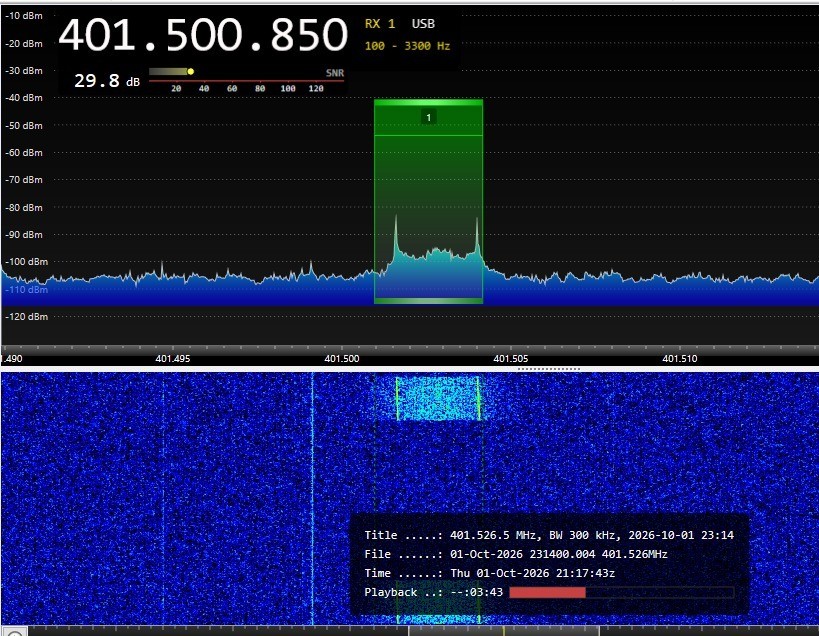
Reception of the OSSIE-D signal around 401.5 MHz on 1 October at 21:17 UTC, about three hours after lift-off. Top, the spectrum; bottom, the waterfall. The signal stands about 30 dB above the noise.
A few hours after launch, the OSSIE-D signal was already being received on the ground. The screenshot shows a clean carrier near 401.5 MHz, standing well above the background noise. It is the first confirmation that the vehicle is alive and working in orbit.
Inside OSSIE-D travel UNNE-1B and its companion HADES-L, both from AMSAT-EA. Once the vehicle is stable, it will release them into space. From then on UNNE-1B will deploy its antenna and start sending its own telemetry on 436.888 MHz.
What comes next
Release of UNNE-1B from OSSIE-D, in the coming days.
Antenna deployment and first signals on 436.888 MHz.
The Transporter-18 Falcon 9 lifted off from California at 18:32 UTC and placed 130 payloads in orbit. Among them, the first Spanish orbital transfer vehicle, with the Nebrija University satellite on board.
18:32 UTCLift-off (20:32 in Spain)
520 kmDeployment altitude
27,660 km/hOrbital speed
130Payloads on board
Thursday 1 October, 20:32 Spanish time. Fourteen minutes later than first scheduled, the SpaceX Falcon 9 lifted off from pad SLC-4E at Vandenberg Space Force Base, California. It was the 25th flight of first stage B1082, which landed seven and a half minutes later at Landing Zone 4, a few kilometres from where it started.
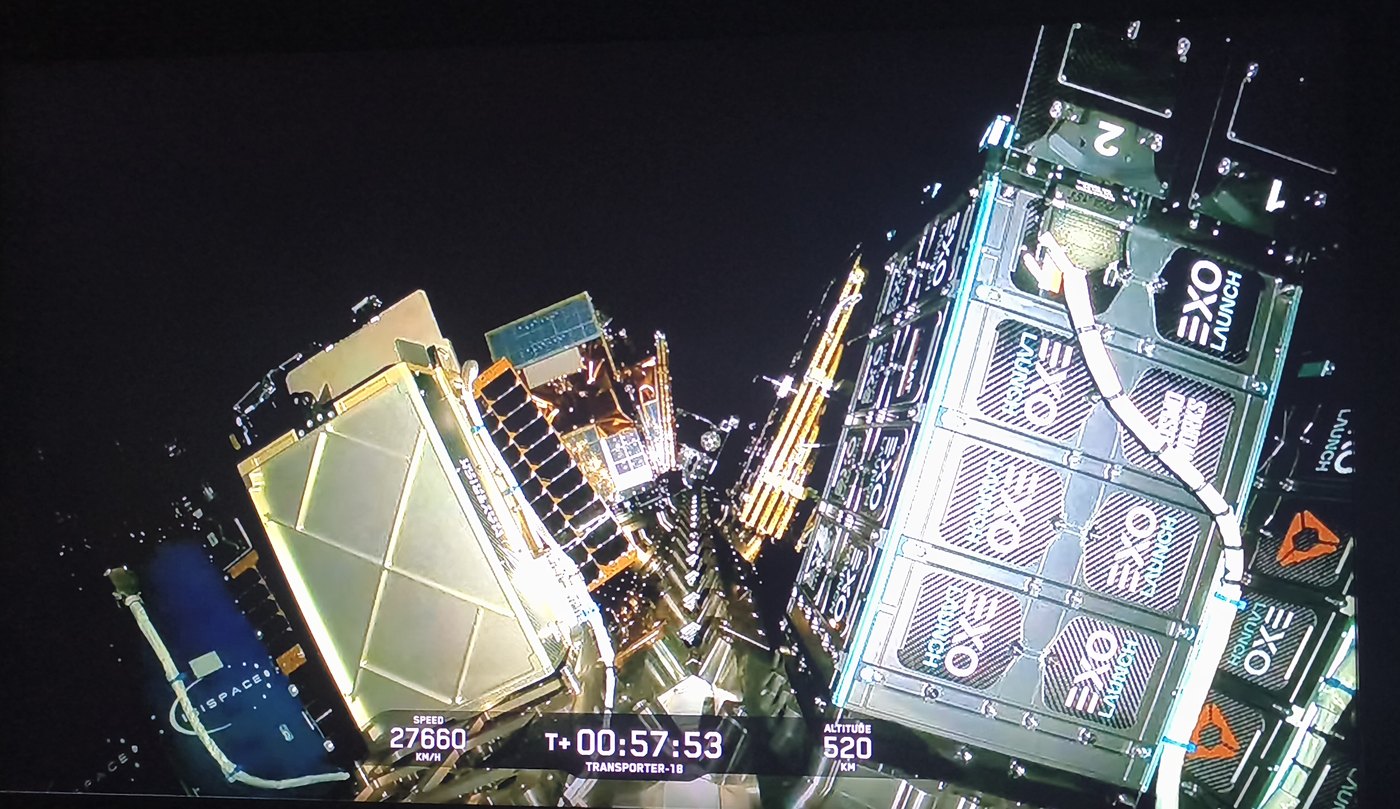
Meanwhile, the second stage continued to a polar orbit. 54 minutes into the flight, already 520 km up and travelling at more than 27,000 km/h, payload deployment began: cubesats, microsats and four orbital vehicles.
T+00:57:53: the second-stage dispensers start releasing satellites at 520 km and 27,660 km/h. Image from the SpaceX webcast.
OSSIE-D, the Galician «space taxi»
One hour after lift-off, OSSIE-D separated: the orbital transfer vehicle of UARX Space, based in Nigrán (Galicia, Spain). It is the first of its kind built in Spain and the result of two and a half years of work.
Its job is to collect small satellites after the rocket's deployment and drop them in the right orbit. On this maiden flight it carries, among others, UNNE-1B and HADES-L.
For UARX it is «a milestone» and «a great step forward for Europe and especially for the Spanish space sector».
OSSIE-D mission patch. Image: UARX Space.
A Nebrija University game, in orbit
UNNE-1B, operated by AMSAT-EA, carries an Arduino board with a deduction game programmed by the ARIES group at Nebrija University. Once OSSIE-D releases it, the satellite will start broadcasting an encrypted message, week by week. Decrypting it is the goal of the Space Cowboy II challenge, open to anyone with a radio receiver.