Researchers of Smarttour-INN participated in the 33rd IFITT eTourism Conference (ENTER26), a leading international forum at the intersection of tourism and information and communication technologies. Under the theme “Advancing Tourism Technology for a Better Future”, ENTER26 focused on how digital transformation can be harnessed to support tourism systems that are not only technologically advanced, but also more inclusive, ethical and sustainable.
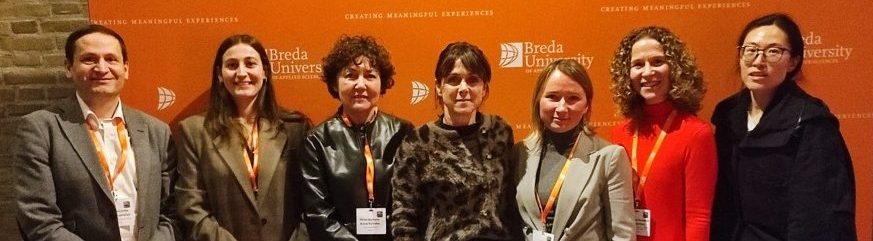
About ENTER26
Building on more than thirty years of academic legacy, ENTER continues to serve as a key global platform for researchers, practitioners, policymakers and technology developers. The 2026 edition addressed the growing responsibilities associated with digital innovation, including the rise of artificial intelligence, data-driven destination management, immersive digital experiences and algorithmic decision-making. Central to these discussions was the question of how technological change can be aligned with societal value, environmental responsibility and equitable outcomes in tourism.
Smarttour-INN Research Contributions
Within this context, Smarttour-INN researchers presented three research papers that contributed to ongoing debates on tourism governance, sustainability and visitor experience in digitally mediated environments.
Full Paper 1: Carbon Calculators
The full paper “Embedding Carbon Calculators in Tourism Governance and Management”, by Aitziber Pousa-Unanue, Aurkene Alzua-Sorzabal, Volha Herasimovich, and Basagaitz Guereño-Omil, examined the role of digital carbon footprint calculators in supporting sustainability-oriented governance and management in tourism destinations.
Based on five semi-structured group interviews with representatives from Spanish destination management organisations, the study tested a prototype visitor carbon calculator to assess its usability, scope and governance value. The findings revealed a general openness to adopting such tools, although their current use tends to remain symbolic or awareness-oriented rather than strategically embedded.
Key challenges were identified with respect to usability, limited segment-specific design, and underutilisation of visitor emissions data for strategic planning. The paper demonstrated how co-designed carbon calculators can support both educational and governance objectives, while underlining the need for greater institutional preparedness and technological adaptability to enable data-driven transitions towards low-carbon tourism.
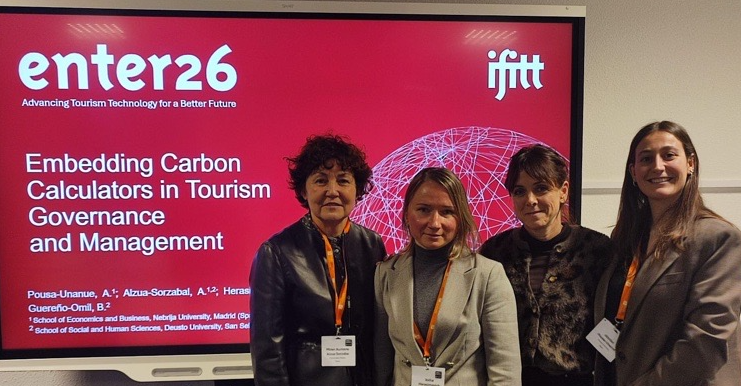
Presentation of the paper “Embedding Carbon Calculators in Tourism Governance and Management”
Full Paper 2: Tourism Destination Networks
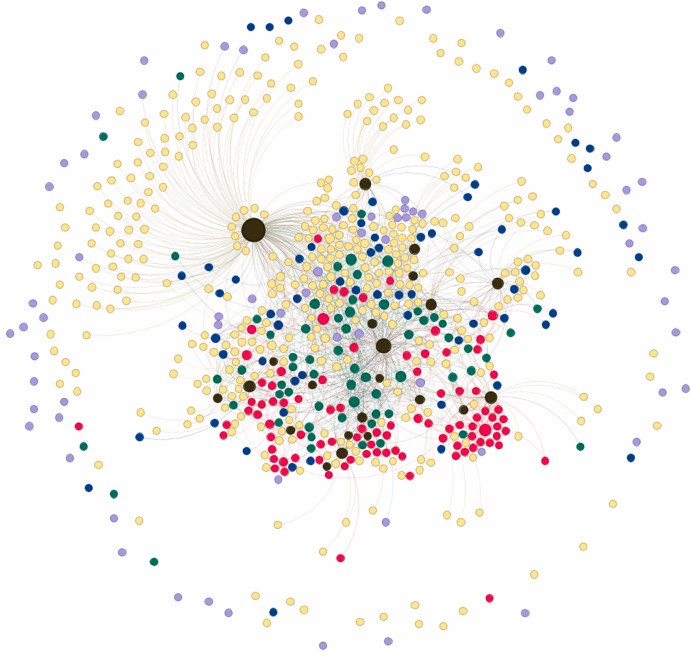
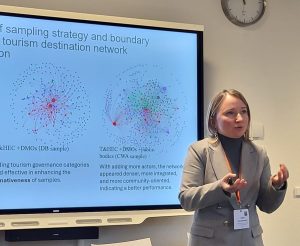
The full paper “What is a Tourism Destination Network? Comparing Hyperlink Network Analysis Approaches for Governance”, by Volha Herasimovich, Aurkene Alzua-Sorzabal, Basagaitz Guereño-Omil, Peng A. Yang, and Juho Pesonen, addressed the methodological challenges of analysing tourism destinations as socio-technical systems undergoing intertwined digital and sustainability transitions.
Focusing on hyperlink networks as a publicly accessible and underexplored data source, the study compared different Hyperlink Network Analysis approaches to examine how methodological choices, including sampling strategies, boundary definition and the online presence and identity of tourism actors, shape network representations.
The findings showed that database-driven approaches can omit up to 97% of relevant actors and systematically exclude non-commercial stakeholders, undermining the reliability of governance insights derived from incomplete networks. The paper emphasised the need for tailored, context-sensitive data collection strategies that combine digital tools with local knowledge and verification processes to support more inclusive and robust destination governance. This research was conducted by researchers of Nebrija University in collaboration with the University of Deusto and the University of Eastern Finland.
Short Paper: AI in Museum Apps
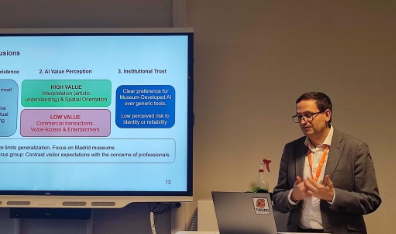
The short paper “Artificial Intelligence in Museum Apps: Insights from Visitor Surveys in Madrid”, by Juan Vicente Calle-Lamelas, Volha Herasimovich, Daniela Thiel-Ellul, and Aitziber Pousa-Unanue, examined the integration of artificial intelligence into mobile applications for museum visits. Drawing on a visitor survey conducted in five major museums in Madrid, the study analysed visitor perceptions of AI-enabled functionalities.
Results indicated that visitors particularly value AI features that enhance autonomy and understanding, such as personalised explanations, image recognition and spatial guidance, while entertainment-oriented or commercial functions are considered less relevant. The findings also revealed a high level of trust in museum-authored AI systems and strong expectations regarding their capacity to deliver more personalised, accessible and engaging visitor experiences in cultural tourism contexts.
Co‑creation Sessions
In parallel, researchers from Smarttour-INN actively participated in two co-creation sessions that fostered interdisciplinary exchange and collaborative reflection. Aurkene Alzua-Sorzabal co-chaired the co-creation sessions “Network Analysis in Tourism” and “How will AI change eTourism research?” with recognised experts in the field, including Rodolfo Baggio, Matthias Fuchs, Wolfram Höpken, and Juho Pesonen.
The first session addressed conceptual and methodological challenges associated with applying network approaches in tourism research, with particular attention to destination governance, digital ecosystems and issues of methodological comparability. The second session examined the implications of artificial intelligence for research design, ethics and knowledge production, highlighting both the opportunities and the emerging risks associated with AI-supported tourism research.
Doctoral Participation
Smarttour-INN’s participation was rounded off by Ruipu Liang, a PhD student in tourism, who attended the predoctoral workshop. Her research, entitled “Evaluate and Design AI-powered Travel Assistants: A Cross-Disciplinary Framework”, uses the BERTopic technique to analyse more than 1,700 scientific abstracts.
Highlights & Impact
Overall, participation at ENTER26 strengthened the international visibility of the Smarttour-INN research activity and reaffirmed its commitment to advancing knowledge on intelligent, responsible and future-oriented tourism systems through rigorous research and international collaboration.
Acknowledgements
The two full papers presented at ENTER26 were supported by Grant PID2021-127893OB-100 funded by MICIU/AEI/10. 13039/501100011033 and by ERDF/EU.